
AI‑900 is Microsoft’s entry point to artificial intelligence on Azure. It was built for people from both technical and non‑technical backgrounds, and it asks you to describe rather than to build: what a workload does, which Azure service fits it, and what responsible use of it looks like. There is no coding, and no data science background is assumed.
That makes it one of the most approachable certifications in the industry, and one of the most useful to hold while AI moves into every job description. It is also the exam this guide is built around — we wrote a full visual book for it, and 429 free practice questions.
Before you start: which exam is current
Microsoft retired the AI‑900 exam on 30 June 2026 and replaced it with AI‑901. The certification you earn is unchanged — Microsoft Certified: Azure AI Fundamentals — but it is now awarded for passing AI‑901.
The two exams are not the same shape. AI‑900 was five “describe” domains with no coding. AI‑901 is two domains, and 55–60% of it is implementing AI solutions with Microsoft Foundry, which expects Python syntax and familiarity with REST APIs, SDKs and CLIs. Everything below still describes the concepts that carry across — the AI vocabulary, the machine‑learning principles, the responsible‑AI framework — which is the ground both exams stand on. Check the official exam page before you book.
What AI‑900 covers
Microsoft groups the exam into five skill areas and publishes a weight range for each rather than a fixed number of questions. Generative AI carries the largest single share, which reflects where the platform has moved.
- Describe artificial intelligence workloads and considerations — 15–20%
- Describe fundamental principles of machine learning on Azure — 15–20%
- Describe features of computer vision workloads on Azure — 15–20%
- Describe features of natural language processing workloads on Azure — 15–20%
- Describe features of generative AI workloads on Azure — 20–25%
How the exam is scored
You need 700 out of 1000 to pass. The most common mistake is reading that as 70% — it is a scaled score, so questions are not worth the same as each other and 700 does not correspond to any fixed number of correct answers.
Expect roughly 40 to 60 questions in about 60 minutes, in multiple‑choice and multiple‑response formats. There is no penalty for a wrong answer, so never leave one blank.
Why this certification is worth holding
AI‑900 is the certification that lets a non‑engineer speak precisely about AI. That is its real value: it is short, it is cheap next to role‑based exams, and it gives an analyst, a project manager or a support engineer the vocabulary to be trusted in a conversation about an AI project.
It also opens a door. It is not a prerequisite for anything, but it is the natural first step toward Azure AI Engineer Associate and Azure Data Scientist Associate, and it sits on a CV as evidence that you understood the ideas before you claimed the tools.
A study plan that works
Study by objective, not by cramming. Take one objective, read it, then answer questions on that objective immediately while it is still fresh. Reading an explanation right after you got something wrong is where nearly all of the learning happens — far more than re‑reading the material a second time.
Give the heaviest areas the most room: generative AI and machine‑learning principles. Responsible AI runs through the whole exam rather than sitting in one corner of it, so treat its six principles — fairness, reliability and safety, privacy and security, inclusiveness, transparency, accountability — as something you can recite.
Leave the last few days for mixed practice. The real exam jumps between topics, and switching cost is a genuine skill that studying one domain at a time never trains.
Practise every objective, free
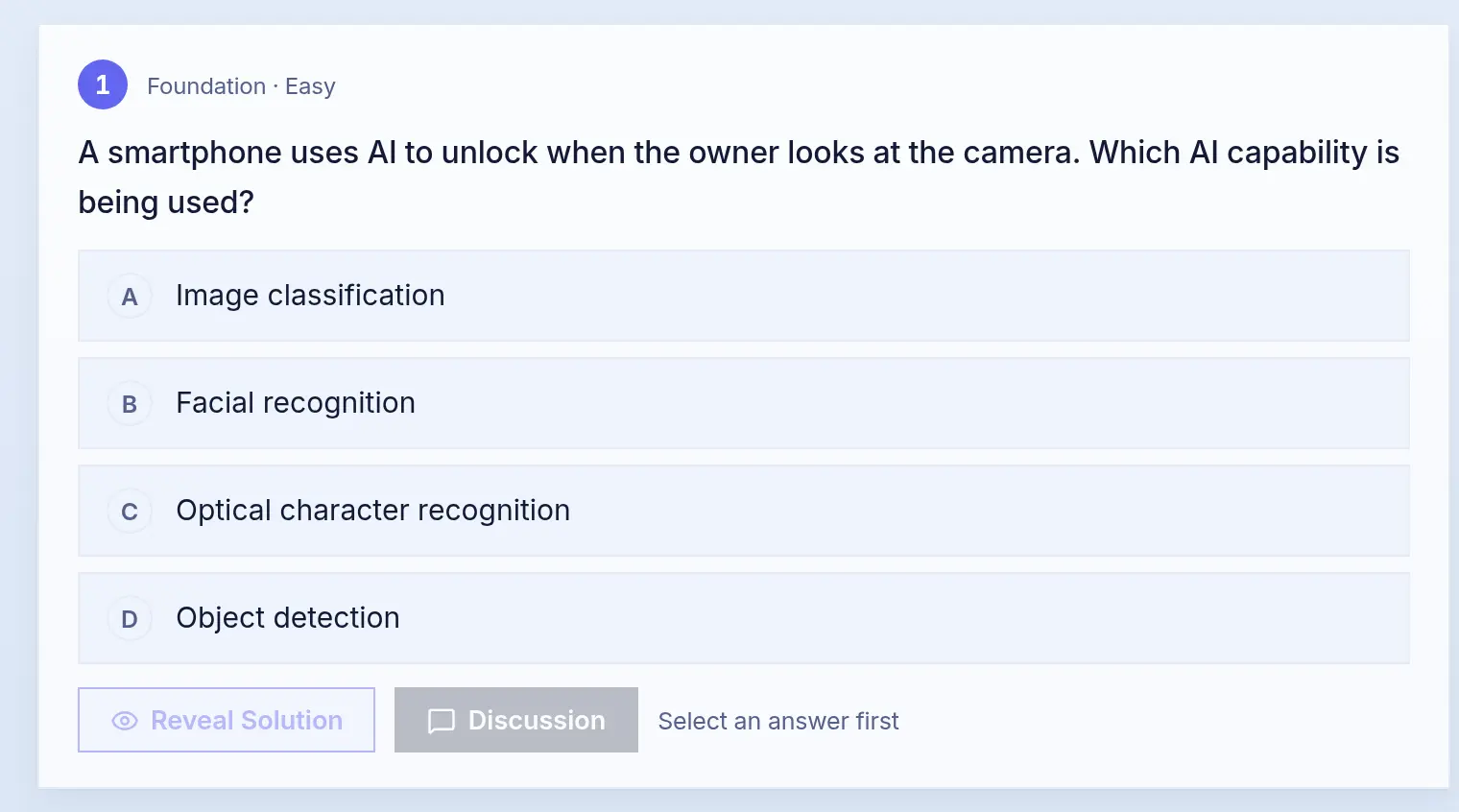
Examers carries 429 free practice questions for AI‑900, across 91 pages covering all 11 objectives. No account, no trial, no card — the questions are free and they stay free. Each page gives you a handful of questions and a written explanation for every option, so a wrong answer teaches you something instead of just costing you a mark.
That is the whole point of a question bank: you find out what you do not know while it is still cheap to find out.
When questions alone are not enough
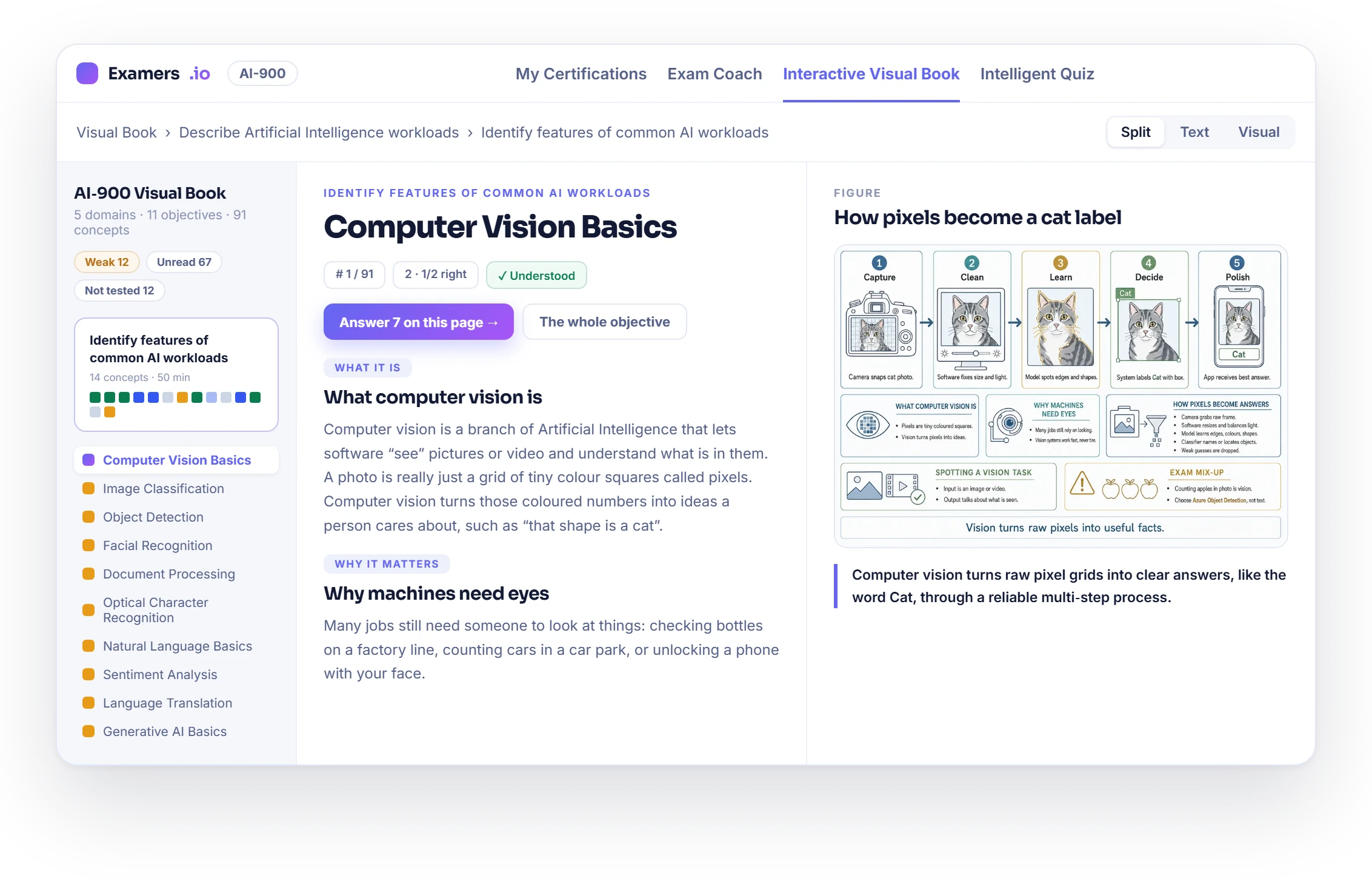
Practice questions tell you where you are weak. They are worse at fixing it — an explanation under a question is a paragraph, and some ideas need a picture and a page.
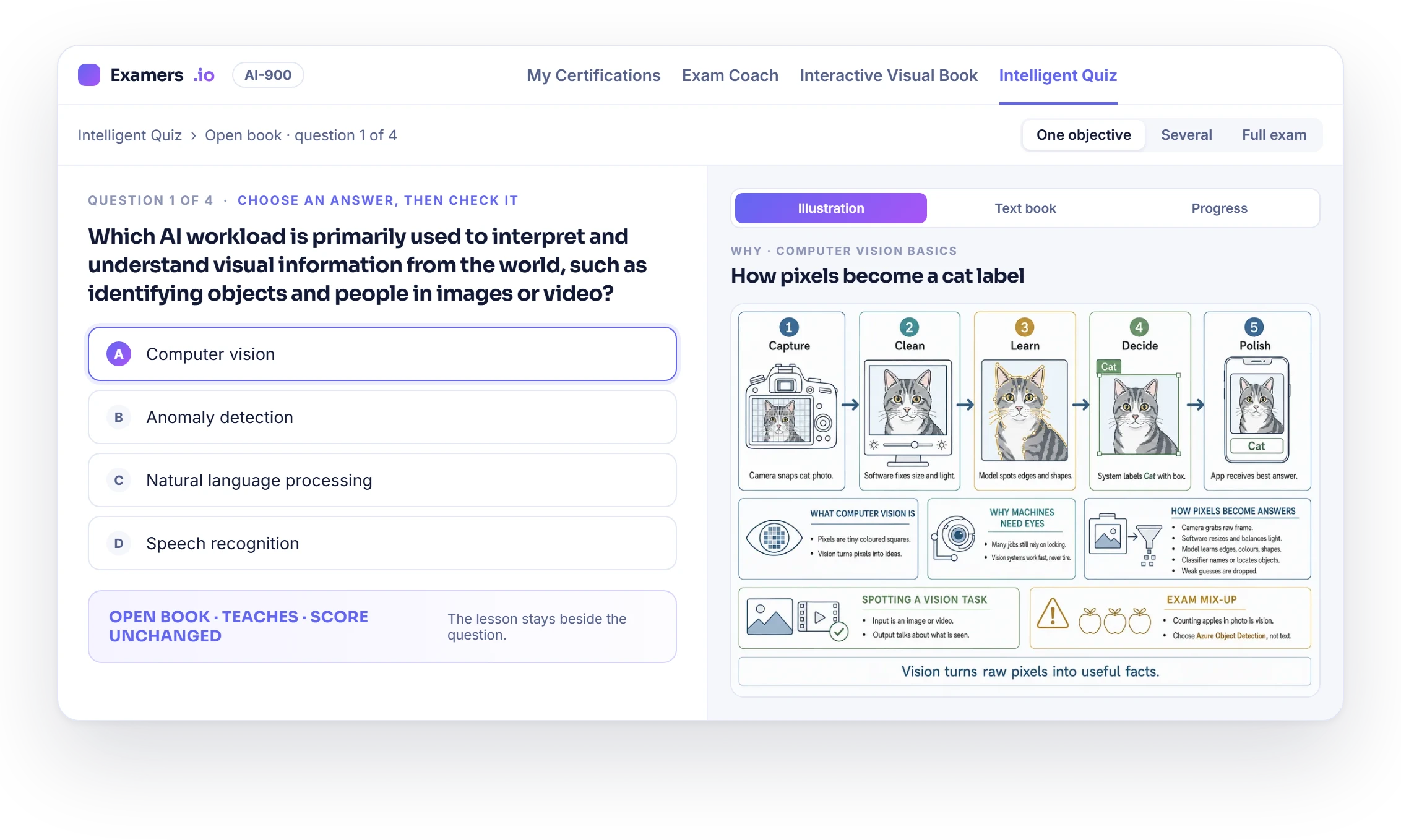
So we wrote the book. Every one of the 91 concepts in AI‑900 is taught properly, in plain language, with illustrations drawn for the idea rather than stock images dropped beside it, and 511 knowledge checks built into the text so you find out whether you understood a page before you leave it.
Practice that targets your weak spots
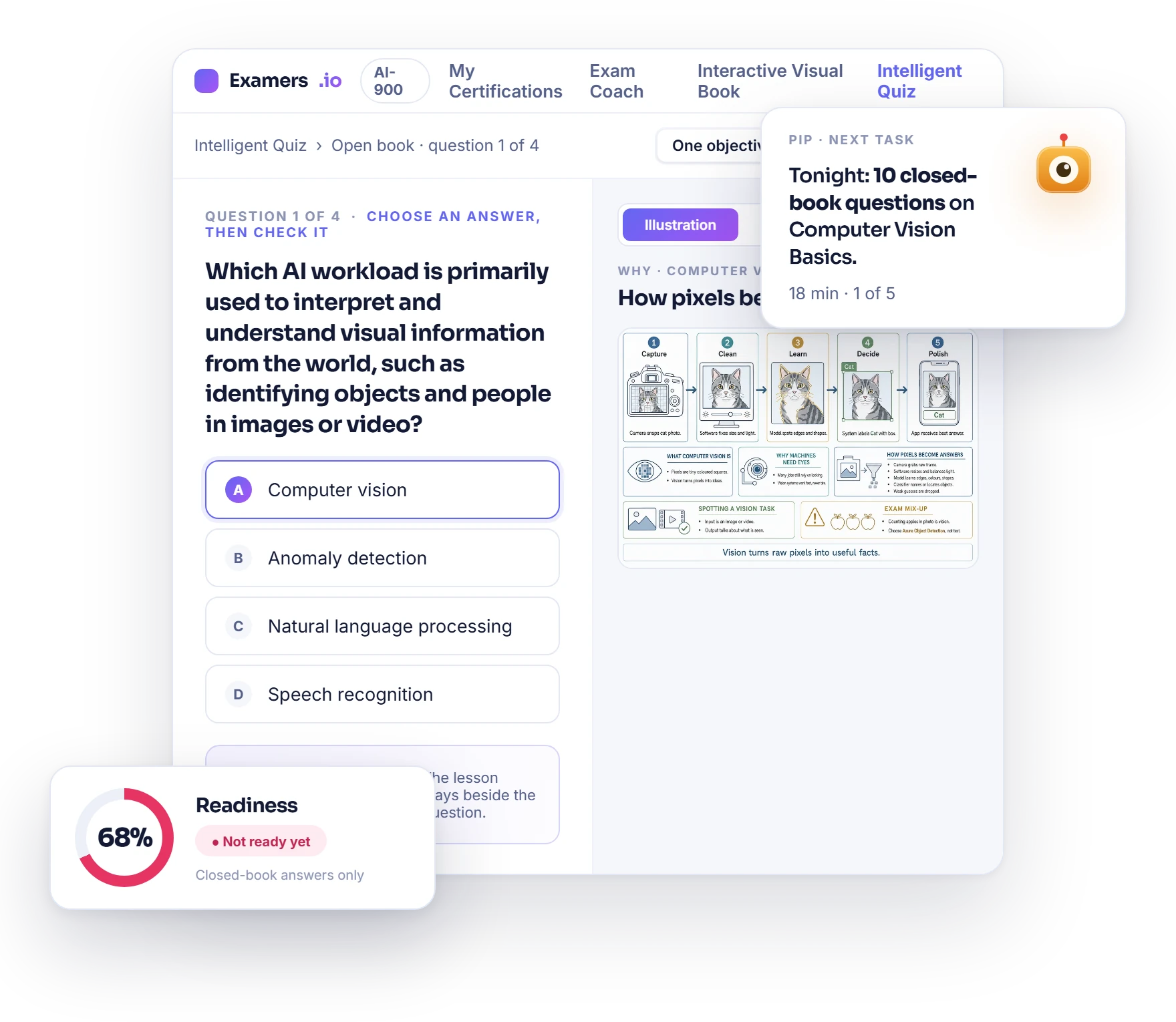
The Intelligent Quiz watches which objectives you keep missing and sends the next questions there. It also runs full timed mocks under real exam conditions, which is the only honest way to find out whether you can hold accuracy for an hour rather than for five questions.
When you get one wrong, the concept it came from is one click away — the question and the explanation of it live beside each other, so you close the gap while you can still feel it.
Know when you are actually ready
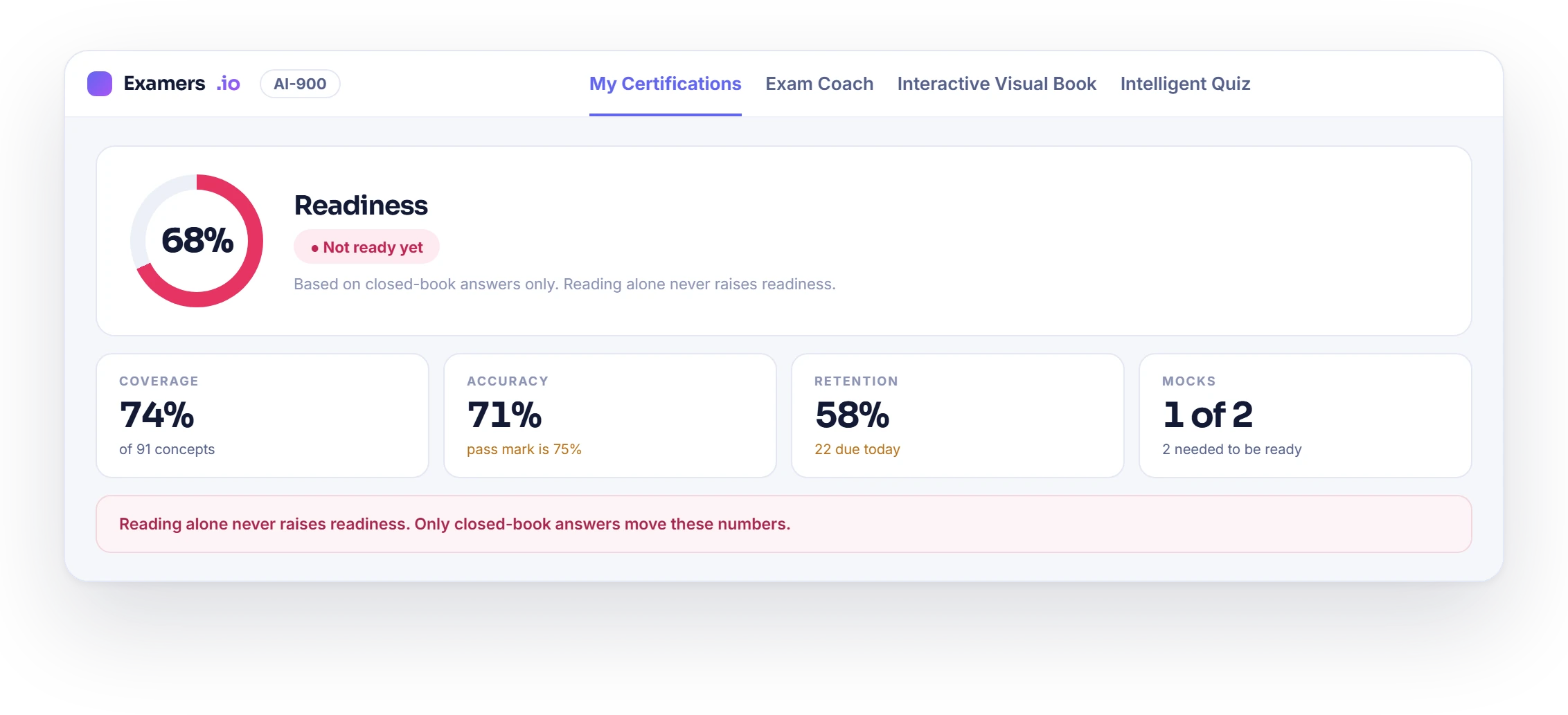
Most people book the exam on a feeling. Readiness is not a feeling and it is not one number — it is evidence across three things: have you covered every objective, is your accuracy on mixed questions comfortably above the bar, and can you repeat that under time without slowing down.
The app measures all three from what you have actually answered and tells you the truth, including when the truth is “not yet”. It will never tell you to stop — but it will not tell you that you are ready when you are not, which is the more expensive lie.
What it costs
The free question bank is free, permanently. The book, the Intelligent Quiz and the Exam Coach sit in the app on a small subscription with a one‑time activation for each certification you take on, and one subscription covers several certifications at once — so the second exam you prepare for costs far less than the first.
Set that against a single exam retake and the arithmetic makes itself. Current prices are on the pricing page.
The short version
Learn the vocabulary, learn the six responsible‑AI principles until you can list them, spend your time in proportion to the published weights, and practise until your accuracy holds under a clock rather than on a good afternoon. Start with the free questions — they will show you quickly enough whether you need the rest.